
6 Key Signs That Professionals Use to Check for Mold
Published
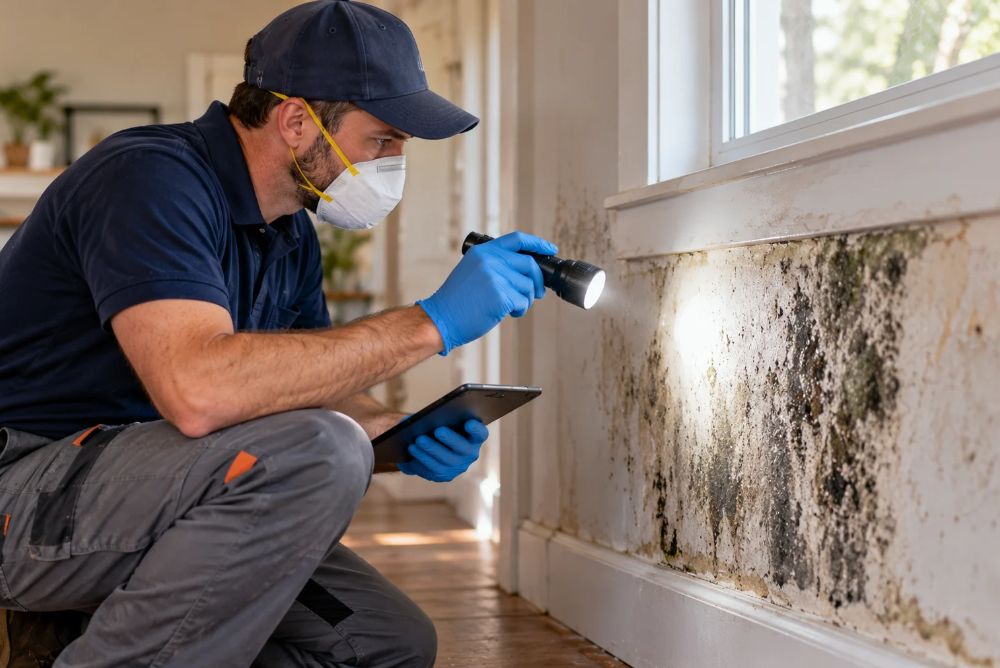
Professionals look for signs of mold that go beyond what a homeowner usually notices, combining a visual check with moisture readings and, when needed, air or surface sampling. This layered approach catches growth hiding behind walls, under flooring, or inside HVAC systems long before it becomes obvious.
Here are the six signs professionals rely on, and what each one tells them.
1. Visible Growth and Discoloration
The first and most direct sign of mold is growth you can actually see. Trained inspectors know that color and texture vary widely, so mold doesn’t always look the way people expect.
They check predictable spots first: bathrooms, kitchens, basements, window frames, and areas near the HVAC system. Discoloration, fuzzy texture, and dark spotting on drywall, grout, or wood trim are all visible signs of mold. Inspectors work with a flashlight in low-light areas like closets and under sinks, since early growth is often faint.
2. A Persistent Musty Odor
A musty odor is often the first clue a professional notices, even before any staining shows up. Mold releases distinct compounds as it grows, and a trained nose can pick that up quickly.
Professionals track the smell to its strongest point, since odor usually concentrates within a few feet of the source. If the smell persists after airing out a room and cleaning visible surfaces, that’s a clear sign of mold, indicating a hidden problem behind a wall or under a floor.
3. Elevated Moisture Readings
Because mold needs water to grow, moisture is often the most telling sign that a professional checks for. The EPA notes that investigators commonly use moisture meters to find wet areas where mold may be developing, even in materials that look dry on the surface.
A moisture meter has a thin probe or a flat sensor pressed against the material, and it works on carpet, wallboard, wood, brick, and concrete. Readings that stay elevated in wood framing or drywall usually mean water reached that spot recently, or the material never fully dried after a past leak. Professionals use these readings to both locate hidden mold and track how well an area is drying afterward.
4. Warped, Bubbling, or Stained Building Materials
Building materials react to sustained moisture in predictable ways, and professionals interpret those reactions as signs of mold risk, even without directly seeing growth. Bubbling paint, peeling wallpaper, soft drywall, and warped or cupped flooring all point to water sitting in a material long enough to compromise it.
These changes matter because mold often grows just behind or beneath the damaged surface. A stained ceiling tile or a section of baseboard that feels soft to the touch tells an inspector where to look more closely, even before pulling out any equipment.
5. Hidden Moisture Behind Walls or Under Floors
Some of the clearest signs of mold never reach the surface at all. The EPA explains that investigating hidden mold can be difficult and may require specialized equipment such as borescopes and moisture meters to locate growth behind finished surfaces.
Professionals check areas that rarely get inspected on a routine basis, including behind cabinets, under carpet padding, inside wall cavities near plumbing, and around window frames where condensation collects. A borescope lets an inspector look inside a wall cavity through a small opening without tearing out drywall, which helps confirm what a moisture reading or thermal pattern already suggested.
6. Recurring Growth After Cleaning
Mold that keeps coming back after it’s cleaned is one of the strongest signs of mold professionals take seriously, because it usually means the moisture source was never actually fixed. Wiping away surface growth without addressing what’s feeding it just delays the same problem.
The Washington State Department of Health notes that mold problems in buildings result from water and moisture issues, and that controlling mold means finding and fixing the source rather than repeating the cleanup. When growth returns in the same spot, professional mold testing and remediation can trace the moisture back to its origin and address it directly.
Frequently Asked Questions
Do I need professional testing if I can already see mold?
Not necessarily. The EPA states that sampling is generally unnecessary when visible mold is present, and the moisture source is clear, so the priority is to fix the water problem and clean the affected area.
What tools do professionals use to find hidden mold?
Professionals commonly use moisture meters, borescopes, and sometimes thermal imaging to locate dampness and growth behind walls or under flooring. These tools help confirm a moisture source rather than replace a visual inspection.
Can mold grow without a visible leak?
Yes. High indoor humidity and condensation on cold surfaces can provide enough moisture for mold to grow, even without a plumbing leak or flooding.
Is a musty smell always a sign of mold?
Not always, but it’s worth investigating. A lingering musty odor with no visible cause often means moisture or early growth is present somewhere out of sight.
How can I tell if mold in my home is a serious problem?
Growth that covers a large area, keeps returning after cleaning, or has a strong, persistent odor generally calls for a professional evaluation. A trained inspector can determine whether the underlying moisture issue needs more than surface cleaning.
Conclusion
None of these six signs work in isolation, and that’s the point. A professional builds a picture by combining what they see, smell, and measure, because mold rarely announces itself with just one clue.
If you’ve noticed one or more of these signs of mold in your Thurston County home, H2O Away’s mold testing and remediation team can trace the moisture behind it and address the source directly. Request a free inspection to find out what’s actually going on before a small problem spreads any further.